On Ash Wednesday Pope Francis commissioned more than 1,000 priests who were sent out around the world as ambassadors of mercy.
Pope Francis has called the Missionaries of Mercy to be “signs of this mercy of the Lord,”and the first aspect of this call is to be very available in bringing about that reconciliation of God through the sacred ministry of Confession.
“The second main thrust of this year is for the Missionaries of Mercy to preach about mercy” much like Christ did in his parables of the Lost Sheep, the Lost Coin and the Prodigal Son.
Monsignor Ted Bertagni, one of these missionaries of mercy, will be hearing confessions at St. Columbkille from 3:30 to 4:30 on Saturday.
Showing posts with label Year of Mercy. Show all posts
Friday, June 3, 2016
Sunday, May 15, 2016
Pilgrims of Mercy
Pope Francis said,. “I will have the joy of opening the Holy Door on the Solemnity of the Immaculate Conception. On that day, the Holy Door will become a Door of Mercy through which anyone who enters will experience the love of God who consoles, pardons, and instills hope.”
He went on to say, “I have chosen the date of 8 December because of its rich meaning in the recent history of the Church. In fact, I will open the Holy Door on the fiftieth anniversary of the closing of the Second Vatican Ecumenical Council. The Church feels a great need to keep this event alive. With the Council, the Church entered a new phase of her history. The Council Fathers strongly perceived, as a true breath of the Holy Spirit, a need to talk about God to men and women of their time in a more accessible way. The walls which for too long had made the Church a kind of fortress were torn down and the time had come to proclaim the Gospel in a new way. It was a new phase of the same evangelization that had existed from the beginning. It was a fresh undertaking for all Christians to bear witness to their faith with greater enthusiasm and conviction. The Church sensed a responsibility to be a living sign of the Father’s love in the world”
In coordination with the universal Church, Archbishop Lucas designated and opened Doors of Mercy a St. Cecilia Cathedral in December. Archbishop Lucas invited pilgrims to participate in this Year of Mercy in a special way today on Pentecost.
After passing through the Doors of Mercy, we were directed down the main aisle and invited to place grains of incense in the brazier.
Incense is often used in Mass, partially as a reminder that just as incense rises, so too do our prayers rise to heaven.
In his homily, Archbishop Lucas reminded us that the disciples had gathered in the upper room "frightened and confused. There they did what most of us do when we're frighten and confused -- which is nothing, though they did pray." Then filled with the Holy Spirit they enthusiastically went into the world."
Archbishop Lucas also reminded us that "The Holy Spirit dwells in you. and the reason the Holy Spirit dwells in you is because He hopes to work through you."
He went on to say, “I have chosen the date of 8 December because of its rich meaning in the recent history of the Church. In fact, I will open the Holy Door on the fiftieth anniversary of the closing of the Second Vatican Ecumenical Council. The Church feels a great need to keep this event alive. With the Council, the Church entered a new phase of her history. The Council Fathers strongly perceived, as a true breath of the Holy Spirit, a need to talk about God to men and women of their time in a more accessible way. The walls which for too long had made the Church a kind of fortress were torn down and the time had come to proclaim the Gospel in a new way. It was a new phase of the same evangelization that had existed from the beginning. It was a fresh undertaking for all Christians to bear witness to their faith with greater enthusiasm and conviction. The Church sensed a responsibility to be a living sign of the Father’s love in the world”
In coordination with the universal Church, Archbishop Lucas designated and opened Doors of Mercy a St. Cecilia Cathedral in December. Archbishop Lucas invited pilgrims to participate in this Year of Mercy in a special way today on Pentecost.
This morning 77 parishioners from St. Columbkille parish participated in a pilgrimage to St. Cecilia Cathedral to be a part of this. A pilgrimage is a journey on foot to a holy place. The practice of pilgrimage dates from the earliest civilizations and is common to many cultures including Judeo-Christian. Abraham and Sarah and their household walked to the place of God’s promise. The Jews left the slavery of Egypt and wandered forty years before entering the promised land. Jesus and his family traveled every year to Jerusalem for the feast of Passover. Throughout the centuries Christians have continued the practice of a holy journey. Many brave and hardy pilgrims trekked to the Holy Land at the risk of life and limb. Others traveled the road to Canterbury or followed the Camino to Santiago de Compostela and the “end of the earth.” These trips were not undertaken lightly. A sizable number of pilgrims set out never to return home.
Most modern pilgrimages aren't as dangerous, but true pilgrims still undertake them with great seriousness. This was a simple journey taking only part of a day, but the spiritual gifts it offers cannot be gained without intentionally turning away from sin and towards the Father whose mercy overflows for his children. Passing through the holy door is a truly worthy goal in this Jubilee year. We are invited to know what pilgrims have always known – “The Lord redeems the life of his servants; none of those who take refuge in him will be condemned,” (Ps 34:22).
Everyone from St. Columbkille received a blessed medal. Besides being a worthy remembrance of Pentecost, for those from St. Columbkille there is the reminder that in Gaelic "Columbkille" means "Dove of the Church." So we remember St. Columbkille, Pentecost, and the Year of Mercy with this reminder.
Reconciliation was available in front
of the Cathedral during this event.
Pilgrims were sprinkled with Holy Water
as they approached the doors.
After passing through the Doors of Mercy, we were directed down the main aisle and invited to place grains of incense in the brazier.
We prayerfully prepared for Mass with Archbishop Lucas. In process we prayed not only for ourselves, but for everyone in our St. Columbkille family.
Incense is often used in Mass, partially as a reminder that just as incense rises, so too do our prayers rise to heaven.
In his homily, Archbishop Lucas reminded us that the disciples had gathered in the upper room "frightened and confused. There they did what most of us do when we're frighten and confused -- which is nothing, though they did pray." Then filled with the Holy Spirit they enthusiastically went into the world."
Archbishop Lucas also reminded us that "The Holy Spirit dwells in you. and the reason the Holy Spirit dwells in you is because He hopes to work through you."
Friday, January 22, 2016
Behold the Lamb of God
I have glasses, but I usually don't wear them.
My nearsightedness hasn't been too bad. I've only noticed it in certain circumstances -- like when I'm seated far away from the action at concerts or sporting events. But during those times, I'm always surprised at how much better I can see when I put my glasses on.
Sometimes I need to slip them on at Mass. When I need them most is just before Holy Communion, when the priest holds up the Consecrated Host and says: "Behold the Lamb of God, behold Him who takes away the sins of the world. Blessed are those called to the supper of the Lamb."
Over time, my nearsightedness has made it difficult to behold Jesus when I sit a distance from the altar. And I think it's important at that moment to physically look at Him, to gaze upon Him disguised in the Host.
At the same time during Mass, I'm reminded of my own sinfulness: "Lord, I am not worthy that you should enter under my roof, but only say the word and my soul shall be healed."
The metaphor of sin as blindness becomes obvious as I'm struggling to see Jesus at Mass. Our sins have a gradual effect on our spiritual vision, diminishing our sight, but in a way we might not notice right away. And slowly but surely, we lose sight of our Lord and the world around us.
We become aware of our shortsightedness when we intentionally behold Jesus, the Lamb of God. If we let Him, He will correct our vision and heal our blindness -- especially in Confession, Holy Communion and the other sacraments.
More and more as I age, I find myself in need of my glasses.
But even more, I know I need to really see.
Inspired by the Year of Faith, Susan Szalewski began writing weekly columns for us. Although that year is over, we liked them so well that we asked her to keep writing. Thankfully, she said yes. So watch for these on Thursdays and see the Year of Faith Blog here.
Saturday, December 12, 2015
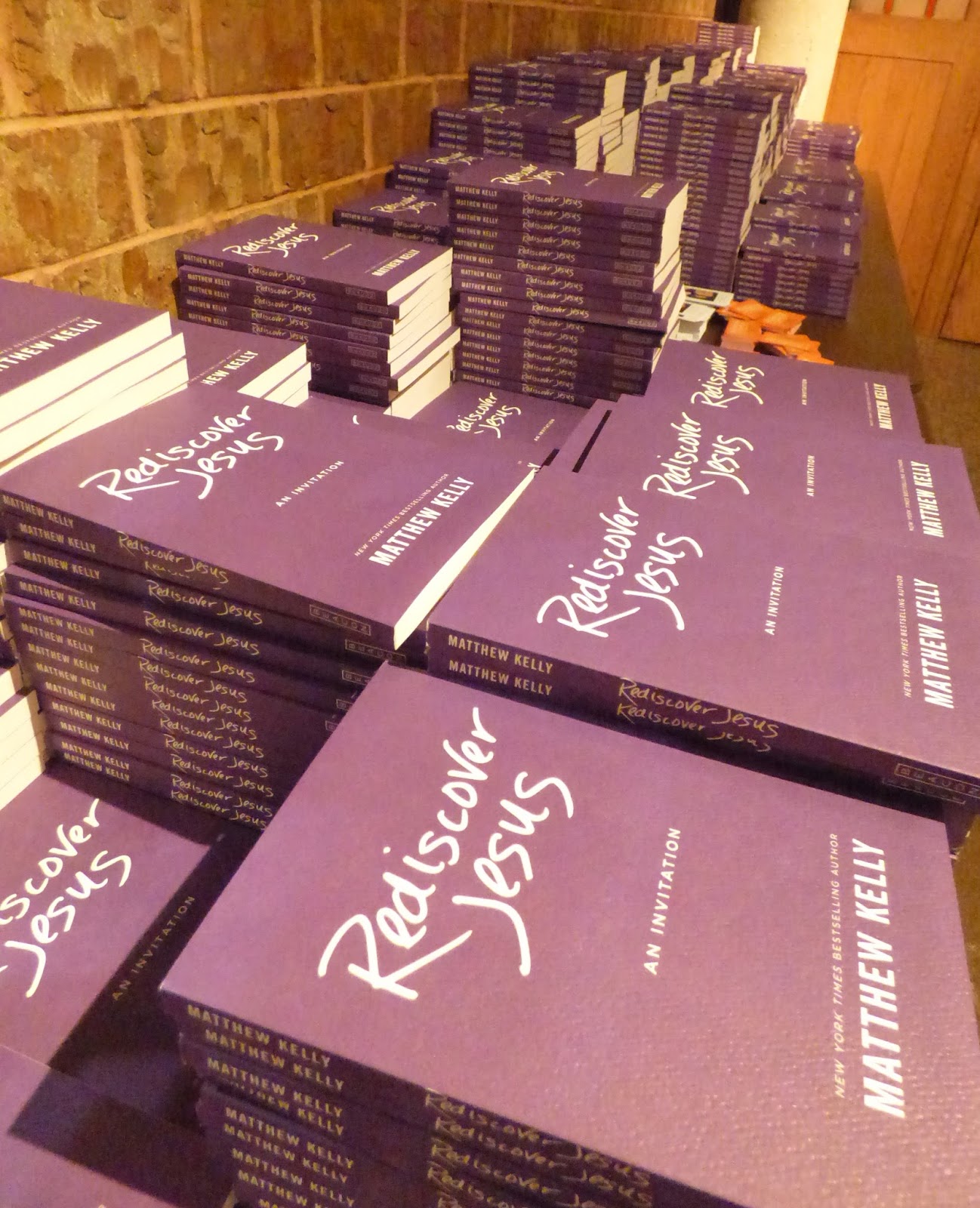
Rediscover Jesus
Free copies of Matthew Kelly's book Rediscover Jesus are available in the church this weekend. It is the book SPIRITuality ALIVE will be using during Lent -- but you can get a headstart on it now.
Also available are prayer cards for the Year of Mercy and reminder cards that Matthew Kelley will be speaking in the Ralston Arena in July.
Thursday, December 3, 2015
Preparing for the Year of Mercy
As we begin the Jubilee Year of Mercy on Dec. 8, the Solemnity of the Immaculate Conception, we might ask: What does mercy even mean?
A dictionary defines mercy as "compassion or forgiveness shown toward someone whom it is within one's power to punish or harm."
One of my high school teachers was a little more Catholic in her definition, calling mercy "a step beyond justice."
Our popes go much deeper.
Pope Francis has described mercy as "the Lord's most powerful message," "a very special capacity for forgetting (He forgets, He kisses you, He embraces you and He simply says to you: 'Neither do I condemn you; go, and sin no more' (Jn 8:11)," "an invitation to conversation" and God's "patience with us."
Pope Benedict XVI said mercy is " the force of God, as the divine limit against the evil of the world," "the central nucleus of the Gospel message; it is the very name of God, the Face with which he revealed himself in the Old Covenant and fully in Jesus Christ, the incarnation of creative and redemptive Love," and "a source of hope for every person and for the whole world."
St. John Paul II, the "Divine Mercy pope," said mercy is "that love which is benevolent, which is compassionate, which raises man above his weakness to the infinite heights to the holiness of God."
God's mercy culminates in the cross, the saint said, "the most profound bowing down of the Divinity towards man."
At the cross, we see mercy in Christ's face, in His gaze and on His lips as He prays for those who torture and kill Him.
In His wounds, in His Precious Blood and in His tormented body, we see the price Jesus paid to unite us completely to Him as His Mystical Body.
"Let us rejoice then and give thanks that we have become not only Christians, but Christ Himself," St. Augustine said. "Do you understand and grasp, brethren, God's grace toward us? Marvel and rejoice: we have become Christ. For if He is the Head, we are the members; He and we together are the whole man."
Together in Christ, we can be mercy for the world. But to be mercy, we must receive it first, as the Catechism of the Catholic Church teaches:
"Now - and this is daunting - this outpouring of mercy cannot penetrate our hearts as long as we have not forgiven those who have trespassed against us. Love, like the Body of Christ, is indivisible; we cannot love the God we cannot see if we do not love the brother or sister we do see. In refusing to forgive our brothers and sisters, our hearts are closed and their hardness makes them impervious to the Father's merciful love; but in confessing our sins, our hearts are opened to His grace."
So let us begin the Jubilee Year of Mercy appropriately -- with the Sacrament of Reconciliation.
And with God's grace, we can be His mercy.
Inspired by the Year of Faith, Susan Szalewski began writing weekly columns for us. Although that year is over, we liked them so well that we asked her to keep writing. Thankfully, she said yes. So watch for these on Thursdays and see the Year of Faith Blog here.
Friday, May 29, 2015
Archbishop Lucas on Mercy
Here is Archbishop George Lucas speaking at the Catholic Professional and Business Club meeting about the upcoming Jubilee Year of Mercy in the Catholic Church and how it applies to Catholics around the world.
Pope Francis's Papal Bull, which Archbishop Lucas referred to, can be found here.
Subscribe to:
Posts (Atom)